 English
 Español
 Русский
Vision/Value: Pragmatism, Integrity, Passion

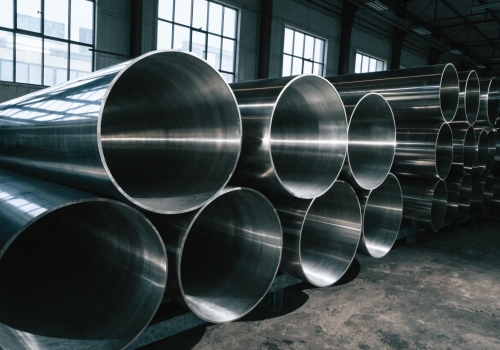
Pipeline failures in high-pressure environments cost millions in downtime and repairs. Are you risking your project integrity with inferior materials? Discover why specific steel choices matter for your engineering success. Large diameter seamless stainless steel pipe offers superior strength and corrosion resistance for critical industries like oil and gas. Unlike welded options, these pipes withstand higher pressure and harsh environments, ensuring long-term reliability and reducing maintenance costs for complex EPC projects.
Many suppliers claim quality, but few deliver consistent results. Let's look at the facts.
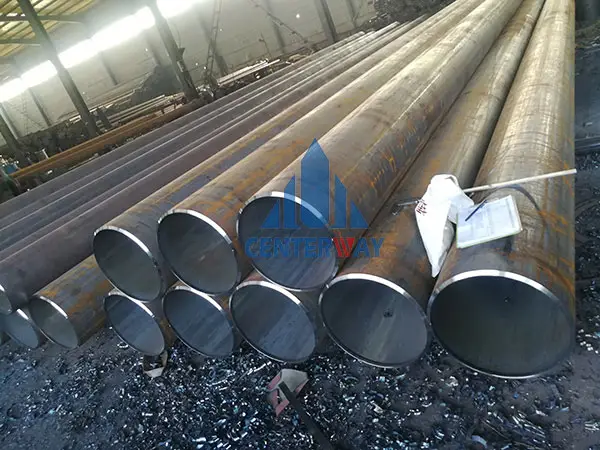
Confusion often surrounds the definition of "large" in the piping industry. Standard mills have size limits, leaving many buyers unsure of where to find the dimensions they need. Typically, seamless pipes exceeding 16 inches (406mm) fall into this category. They are often produced using hot expansion technology, transforming a standard billet into a larger, durable vessel without the weak points found in welded seams.
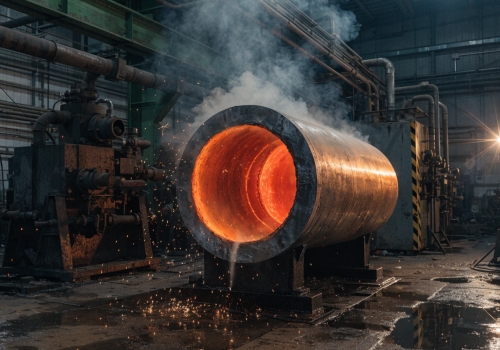
When we talk about large diameter seamless stainless steel pipe, we are usually discussing a very specific niche in manufacturing. Most standard seamless production lines, like cold drawing or standard hot rolling, hit a ceiling around 16 or 20 inches. To go bigger, up to 40 inches or even more, we must use a process called hot expanding. I have seen many clients surprised by this process. Basically, we take a high-quality seamless mother pipe, heat it to a precise temperature where the steel becomes plastic but not melted, and then expand it. This method increases the diameter while maintaining the "seamless" integrity. It is efficient and allows us to produce non-standard sizes quickly. Here is a simple comparison of how these pipes stack up against common welded alternatives:
| Feature | Seamless Pipe (Hot Expanded) | LSAW (Longitudinal Submerged Arc Welding) | SSAW (Spiral Submerged Arc Welding) |
|---|---|---|---|
| Manufacturing Method | Extrusion + Hot Expansion | Steel Plate Molding + Welding | Steel Coil + Spiral Welding |
| Weld Seam | None (0%) | One Straight Seam | Spiral Seam |
| Pressure Rating | High (Uniform Strength) | Medium to High (Depending on weld) | Lower to Medium |
| Roundness | Excellent | Good | Fair |
| Production Range | Up to ~1000mm | Up to ~1500mm | Up to ~3000mm |
Welded seams are historically the weakest point of any piping system. Leaks, cracks, and corrosion almost always start where the metal was joined, creating massive risks. Seamless pipes lack a longitudinal weld, which eliminates the heat-affected zone (HAZ). This uniform structure allows them to handle significantly higher internal pressures and temperature fluctuations compared to their welded counterparts.
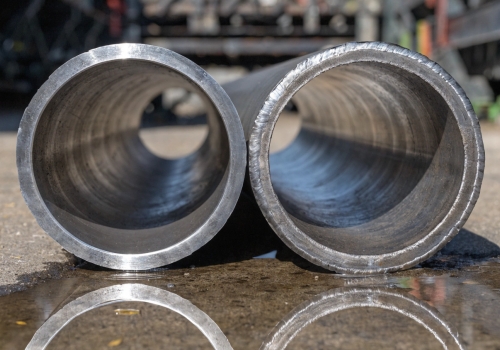
In my 18 years of experience working with EPC companies, I have seen the consequences of choosing the wrong pipe. One project I consulted on used welded pipes for a high-pressure subsea line to save money. Within two years, the stress corrosion cracking along the weld seam caused a failure. It was a disaster. A large diameter seamless stainless steel pipe offers what we call "isotropic strength." This means the strength is the same in all directions. A welded pipe is anisotropic; its strength varies depending on whether you are measuring across the weld or along the body. When you have high pressure flowing through a pipe, the internal force pushes out against the walls. In a welded pipe, that force is constantly testing the integrity of the weld. In a seamless pipe, the load is distributed evenly around the entire circumference. Furthermore, let's talk about the environment. In industries like chemical processing or offshore oil rigs, pipes face harsh corrosive elements. The Heat Affected Zone (HAZ) near a weld is chemically different from the rest of the pipe due to the heating and cooling during welding. This area is prone to "weld decay" or intergranular corrosion. Seamless pipes do not have a HAZ. This makes them naturally more resistant to corrosion, extending the lifecycle of your project significantly.
The market is full of fake certificates and "seamless" pipes that are actually welded pipes with the seam polished away. This deception puts your entire operation at risk. To guarantee authenticity, always demand third-party inspections and mill test certificates. Genuine seamless pipes will show consistent grain structure, while disguised welded pipes often fail ultrasonic testing or hydrostatic pressure tests.
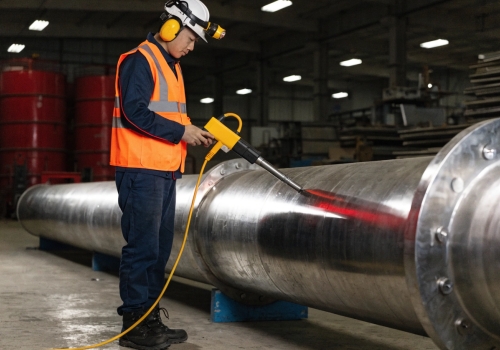
Sourcing a large diameter seamless stainless steel pipe requires a strict vetting process. At Centerway Steel, we treat quality control as our religion. Since we integrate production and sales, we know exactly what goes into the furnace. But for a buyer, how do you verify? First, you must check the Roundness and Wall Thickness Uniformity. Because seamless pipes are extruded and expanded, they are naturally rounder than welded pipes, which are bent from plates. However, controlling the wall thickness during the expansion process is an art. If the manufacturer is inexperienced, the wall thickness might be uneven. We use advanced ultrasonic gauges to ensure the thickness meets ASTM and API standards at every point along the pipe. Second, material verification is non-negotiable. Different projects require different grades of stainless steel.
| Stainless Grade | Typical Application | Key Characteristic |
|---|---|---|
| TP304/304L | General Construction, Water | Good corrosion resistance, cost-effective. |
| TP316/316L | Marine, Chemical, Medical | Excellent resistance to chlorides and acids. |
| TP321/H | High-Temp Steam, Refinery | Stabilized with Titanium for high heat. |
| 904L / Duplex | Severe Offshore Conditions | Extreme corrosion resistance and high strength. |
Finally, never skip the Hydrostatic Test. This involves filling the pipe with water and pressurizing it to a level higher than its operating pressure. A fake seamless pipe (a hidden welded pipe) will often reveal its weakness during this test. We always welcome third-party inspectors like SGS or BV to witness these tests at our facility. It builds trust, and trust is the currency of our business.
Choosing the right large diameter seamless stainless steel pipe ensures safety, longevity, and project success. At Centerway Steel, we provide the expertise and certified quality your global projects demand.