 English
 Español
 Русский
Vision/Value: Pragmatism, Integrity, Passion

Do you struggle to find the exact pressure limits for your piping projects? Wrong pressure estimates cause huge safety risks and cost overruns. We can fix that problem today. The a106 seamless pipe pressure rating depends on the material grade, wall thickness, outside diameter, and operating temperature. For example, an NPS 2 Schedule 80 A106 Gr. B pipe handles 23.70 MPa at 20°C. You must calculate this rating using standard ASME B31.3 formulas.
I will show you the exact charts, calculation steps, and key factors right now. You need this data to keep your pipeline systems safe and avoid buying the wrong materials.
Are you worried about pipes bursting under high internal force? Ignoring physical constraints leads to dangerous leaks on your construction site. Let us look at what truly controls your pipe strength. Five main factors determine the pressure capacity: material grade, wall thickness, outside diameter, operating temperature, and design standards. Changing any of these variables will directly increase or decrease the maximum pressure your pipe can safely handle.
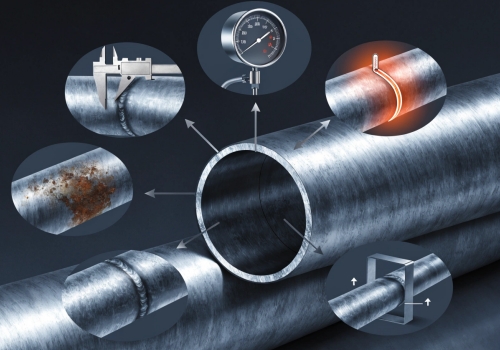
When we supply pipes to construction projects, I always tell buyers to check these specific details. You cannot guess the pressure limits. You need exact data. The material grade sets your base strength. ASTM A106 has three grades: A, B, and C. Grade B is the most common, but Grade C offers higher tensile strength for extreme conditions. Wall thickness acts as your primary defense against internal force. We call this the pipe schedule. A Schedule 80 pipe has thicker steel walls than a Schedule 40 pipe, so it handles higher pressure. The outside diameter also changes the math. If you keep the wall thickness the same but buy a larger diameter pipe, the pressure capacity goes down. The internal pressure stretches across a wider surface area.
| Factor | Impact on Pressure Capacity |
|---|---|
| Wall Thickness | Thicker walls handle higher pressure safely |
| Outside Diameter | Larger diameters handle lower pressure |
| Heat Level | Higher temperatures lower the pressure limit |
| Steel Grade | Higher yield strength improves the base rating |
Do you find engineering formulas confusing? Guessing the numbers puts your entire project at risk. I will give you a simple way to calculate these values accurately. You calculate the safe working pressure using the ASME B31.3 formula: P = 2 × S × E × t / (D − 2 × Y × t). This equation uses allowable stress, wall thickness, outside diameter, and quality factors to find the maximum limit.
To keep your project safe, you must use the right math. Here is exactly how we calculate the Maximum Allowable Working Pressure (MAWP). First, you find the allowable stress (S). For A106 Gr. B at 20°C, this value is 137.9 MPa. Next, you set the quality factor (E). Because A106 is a seamless pipe without weak weld lines, this factor is always 1.0. You must also find the effective wall thickness (t). You cannot use the nominal thickness listed in a catalog. Steel mills have manufacturing tolerances. We usually subtract a 12.5% mill tolerance from the listed thickness. If your system carries harsh fluids, you must also subtract a specific corrosion allowance (like 3mm) from that number. Finally, you measure the outside diameter (D) and use the ASME material coefficient (Y), which is usually 0.4. Let us look at a real case for an NPS 2 Schedule 80 pipe. The allowable stress is 137.9 MPa. The effective thickness becomes 4.85 mm after we remove the mill tolerance. The outside diameter is 60.3 mm. When you put these numbers into the formula, you get a final a106 seamless pipe pressure rating of 23.70 MPa. We run these numbers twice for every order.
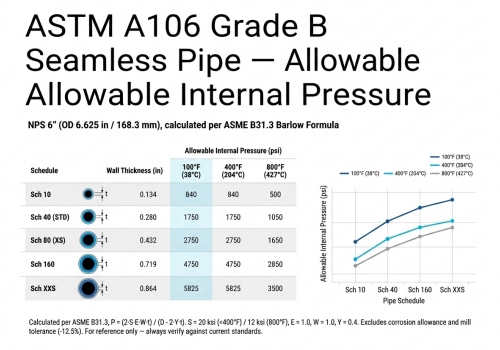
Are you tired of doing manual math for every single pipe? Wasting time on formulas slows down your purchasing process. We prepared a ready-to-use chart for your daily work. The chart below shows the maximum allowable working pressure for common sizes of A106 Gr. B pipes. For example, a 6-inch Schedule 40 pipe handles 10.51 MPa at 20°C. Thicker schedules handle much higher pressures.
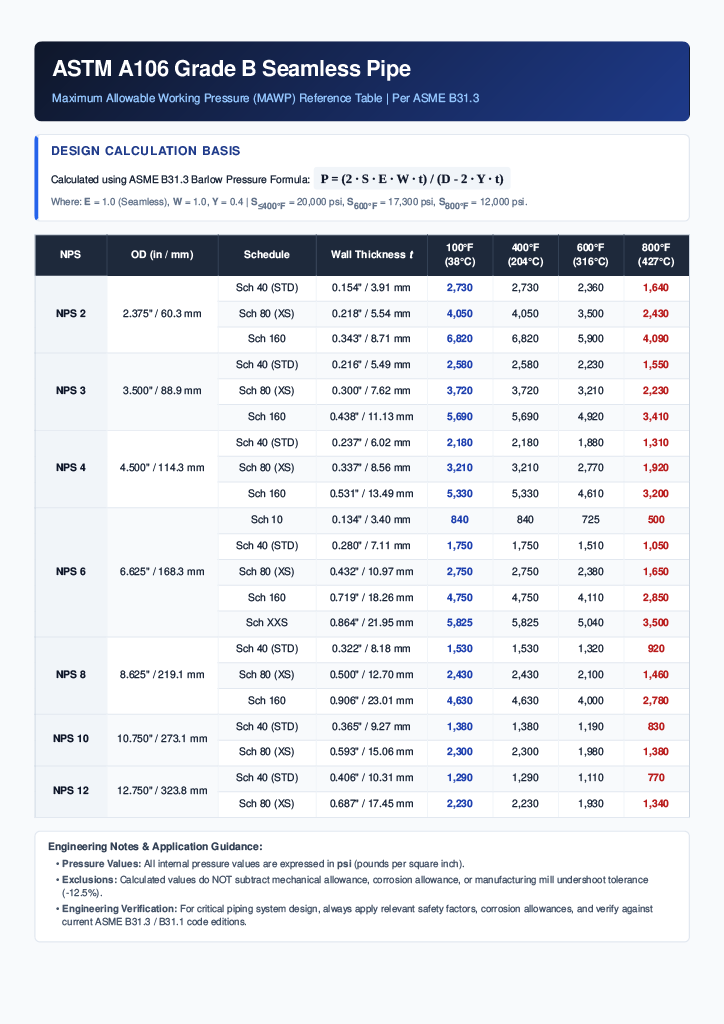
I created this reference chart based on standard ASME B31.3 rules. We assume a 12.5% negative wall thickness tolerance and zero extra corrosion allowance. This table gives you quick answers when you compare pipeline materials and costs.
| NPS Size | OD (mm) | Schedule | Thickness (mm) | Temp (°C) | Stress (MPa) | MAWP (MPa) |
|---|---|---|---|---|---|---|
| 2 | 60.3 | 40 | 3.91 | 20 | 137.9 | 16.39 |
| 2 | 60.3 | 80 | 5.54 | 20 | 137.9 | 23.70 |
| 4 | 114.3 | 40 | 6.02 | 20 | 137.9 | 13.20 |
| 4 | 114.3 | 80 | 8.56 | 20 | 137.9 | 19.07 |
| 6 | 168.3 | 40 | 7.11 | 20 | 137.9 | 10.51 |
| 8 | 219.1 | 160 | 23.01 | 20 | 137.9 | 27.35 |
Do you operate pipes in hot environments like power plants? High heat destroys steel strength fast. Let us see how temperature drops your pipe pressure capacity. As the design temperature rises, the allowable stress of the steel drops. This directly lowers your safe pressure limit. For ASTM A106 Gr. B, the allowable stress falls from 137.9 MPa at 20°C to just 108.9 MPa at 400°C.
In my 18 years of working with engineering pipeline systems, heat is the most ignored factor. Many buyers only look at room temperature charts. This is a massive mistake. When carbon steel gets hot, its internal structure expands and loses stiffness. The ASME code states clearly that you must reduce your allowable stress based on your maximum operating temperature. Look at how the stress limits drop when things get hot:
| Material Grade | Temperature (°C) | Allowable Stress (MPa) |
|---|---|---|
| ASTM A106 Gr. B | 20 | 137.9 |
| ASTM A106 Gr. B | 400 | 108.9 |
| ASTM A312 TP316L | 20 | 115.1 |
| ASTM A312 TP316L | 400 | 64.6 |
Do you still have doubts about choosing the right pipe? Unanswered questions lead to bad purchasing choices and failed inspections. Here are the top answers to clear your mind. People often ask about material differences, corrosion impacts, and testing rules. We compiled these fresh answers based on real engineering problems. This information will help you select the exact specifications for your next big project.
Q1: Can I use A106 Grade A limits for Grade B pipes?
A1: No. Grade B has a higher tensile strength and a different allowable stress than Grade A. You must always use the exact data for Grade B. If you mix them up, you might overpay for unnecessary thickness or create a weak point in your system.
Q2: How does corrosion allowance change the final pressure calculation?
A2: Rust and harsh chemicals eat away your pipe wall over time. We subtract a specific corrosion allowance (like 2mm or 3mm) from the wall thickness before we run the pressure formula. This ensures the pipe remains safe even after years of use.
Q3: What happens if my system exceeds the a106 seamless pipe pressure rating during a test?
A3: Hydrostatic test pressures can temporarily exceed normal working limits safely, based on strict ASME guidelines. But if your daily operating pressure spikes above the calculated MAWP, the steel will deform or burst. You must install pressure relief valves to prevent this.
Q4: Do welded pipes handle the same pressure as seamless A106 pipes?
A4: No. Seamless pipes do not have a weld seam. This means they get a higher quality factor (E=1.0) in the calculation formula. They handle high-stress applications much better than welded pipes of the exact same size and thickness.
Q5: How do I choose between Schedule 40 and Schedule 80?
A5: You calculate your exact system pressure first. If Schedule 40 falls below your required safety margin, you step up to Schedule 80. I always help my clients run these numbers to balance project safety and raw material costs.
The a106 seamless pipe pressure rating depends entirely on size, wall thickness, and operating heat. Contact Centerway Steel today to get exact calculations and premium pipeline products for your next engineering project.